





Artificial intelligence is becoming part of digital transformation, business strategy, and project delivery. As organisations begin investing in AI initiatives, many professionals are asking the same question:
Can I pursue the PMI-CPMAI certification if I do not come from an IT, AI, or technical background?
The short answer is yes.
The PMI-CPMAI certification is focused on managing AI initiatives, not on coding or developing algorithms. You do not need to be a data scientist, software engineer, or machine learning specialist to begin your CPMAI journey.
What you do need is an interest in AI, an ability to work with different stakeholders, and a willingness to understand how AI initiatives are planned, evaluated, governed, and delivered.
What Is the PMI-CPMAI Certification?
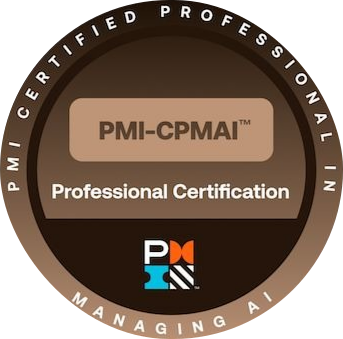
The PMI Certified Professional in Managing AI, or PMI-CPMAI, is a certification designed for professionals who want to understand how AI initiatives are managed throughout their lifecycle.
The certification covers important areas such as:
- Identifying business needs and potential AI solutions.
- Understanding data requirements.
- Managing AI model development and evaluation.
- Supporting the implementation of AI solutions.
- Promoting responsible and trustworthy AI practices.
The focus is not on building AI models from scratch. Instead, it is on helping professionals manage the decisions, people, processes, risks, and business expectations involved in AI projects.
This makes PMI-CPMAI relevant to professionals who work between business teams, technical teams, leadership, and end users.
Do You Need a Technical Background?
No. You do not need prior experience in programming, machine learning, data science, or artificial intelligence to pursue PMI-CPMAI.
PMI’s CPMAI examination content outline states that prior project management, technical, or AI experience is not required. However, familiarity with project or product management and basic AI concepts can be useful when preparing for the certification.pmi
You do not need to know:
- Python or another programming language.
- How to build machine learning algorithms.
- How to design neural networks.
- How to tune an AI model.
- Advanced mathematics or statistical modelling.
- Software engineering.
You should, however, be willing to understand the concepts behind AI projects. A basic familiarity with tools such as ChatGPT can be helpful, but using AI tools is not the same as managing an AI initiative.
What Skills Are Helpful for CPMAI?
A technical background is not essential, but certain professional skills can make the learning journey easier.
These include:
- Project planning and coordination.
- Stakeholder management.
- Business analysis.
- Requirements gathering.
- Risk and issue management.
- Agile or structured delivery experience.
- Change management.
- Communication and facilitation.
- An interest in digital transformation.
AI projects are rarely delivered by one team alone. They often involve business leaders, subject matter experts, data professionals, technology teams, compliance stakeholders, and end users.
A project professional’s role is to help these groups work towards a shared objective. This requires communication, structured decision-making, and an understanding of how the initiative creates value for the organisation.
Who Can Benefit From PMI-CPMAI?
PMI-CPMAI is relevant to a broad range of professionals who are involved in projects, transformation, technology adoption, or business improvement.
Project Managers
Project managers are increasingly being asked to support AI-related initiatives. CPMAI can help them understand how AI projects differ from traditional technology projects, particularly in areas such as data readiness, model evaluation, uncertainty, and continuous improvement.
Program and Portfolio Managers
Program and portfolio managers can use CPMAI concepts to evaluate AI opportunities, coordinate related initiatives, and connect AI investments with organisational priorities.
Business Analysts
Business analysts can benefit from learning how to identify suitable AI use cases, define AI-related requirements, assess data needs, and coordinate between business and technical stakeholders.
Product Managers and Product Owners
Product professionals working with AI-enabled products need to consider customer needs, data, model performance, responsible use, adoption, and ongoing improvement.
Digital Transformation Consultants
Consultants supporting transformation initiatives can use CPMAI knowledge to help organisations evaluate AI opportunities and move from initial ideas to practical implementation.
Operations and Domain Professionals
Professionals working in healthcare, finance, education, retail, manufacturing, and other sectors may find CPMAI useful if they are involved in process improvement, automation, or AI adoption.
Business and Functional Leaders
Business leaders do not need to become technical specialists to participate in AI decision-making. CPMAI can help them understand AI project risks, delivery considerations, governance, and business value.
What Will You Learn Through CPMAI?
The PMI-CPMAI learning journey introduces AI from the perspective of managing initiatives and delivering outcomes.
Understanding AI Projects
AI projects have characteristics that make them different from many traditional projects. Their outcomes can depend on data quality, model performance, evaluation methods, user adoption, and changing business conditions.
Connecting AI to Business Needs
AI should not be introduced simply because a new tool is available. Professionals need to understand the business problem, assess whether AI is an appropriate approach, and define how success will be measured.
Understanding Data Requirements
Data plays a central role in many AI initiatives. Project professionals should understand data availability, quality, relevance, privacy, security, and readiness.
Managing Development and Evaluation
Project managers do not need to develop AI models themselves. However, they should understand how model development, testing, evaluation, feedback, and changes in requirements affect the project.
Supporting Responsible AI
AI initiatives need to consider privacy, fairness, transparency, security, reliability, accountability, and responsible use. These considerations should be addressed throughout the project lifecycle.
Supporting Implementation
Deployment is not the end of an AI initiative. Solutions need to be introduced into the business, adopted by users, monitored, evaluated, and improved over time.
Is PMI-CPMAI Difficult for Non-Technical Professionals?
The difficulty of any certification depends on a learner’s preparation, study habits, and familiarity with the subject.
However, professionals without a technical background may find CPMAI more accessible than expected because the certification is not focused on coding or advanced mathematical concepts. It approaches AI from a project management and business perspective.
Learners are expected to understand the language, lifecycle, risks, decisions, and governance considerations associated with AI projects.
Professionals with experience in project management, product management, business analysis, or digital transformation may already possess several transferable skills, including:
- Planning.
- Communication.
- Stakeholder engagement.
- Requirements analysis.
- Risk management.
- Governance.
- Change management.
- Delivery oversight.
The AI concepts still need to be studied, but they are presented in the context of managing initiatives rather than building AI systems from the ground up.
Who May Not Find CPMAI Suitable?
PMI-CPMAI may not be the right certification for someone looking primarily for:
- Hands-on programming training.
- Advanced machine learning instruction.
- Academic AI or data science education.
- Specialist training in model engineering.
- Deep algorithm development experience.
CPMAI is focused on managing AI initiatives. It is most suitable for professionals who want to understand how AI projects are assessed, planned, governed, delivered, and operationalised.
Is PMI-CPMAI Worth Pursuing?
The value of any certification depends on how well it aligns with your career goals.
PMI-CPMAI may be worth considering if you want to:
- Build confidence in AI project discussions.
- Understand the AI project lifecycle.
- Support AI adoption in your organisation.
- Work more effectively with technical and business teams.
- Strengthen your project management profile.
- Prepare for AI-related project and program opportunities.
- Develop a structured approach to managing AI initiatives.
A certification does not replace practical experience. It can, however, provide a structured learning path and help professionals develop a common understanding of AI project management.
The most useful combination is certification knowledge, practical application, and continued learning.
How to Begin Your CPMAI Journey
If you are considering the PMI-CPMAI certification, begin by understanding what the certification covers and how it fits your professional goals.
A practical starting point is to:
- Review the purpose and scope of the certification.
- Study the PMI-CPMAI examination content outline.
- Become familiar with basic AI concepts.
- Understand how AI projects differ from traditional projects.
- Learn about data, model evaluation, responsible AI, and implementation.
- Enrol in the required PMI-CPMAI examination preparation course.
- Follow a structured study and practice plan.
Completion of the PMI-CPMAI Exam Prep Course is required before scheduling and taking the examination.pmi
Final Thoughts
You do not need to be a coder, data scientist, or AI engineer to pursue the PMI-CPMAI certification.
If you understand projects, stakeholders, business needs, delivery, or transformation, you already have a foundation that can support your learning journey.
CPMAI can help you build on that foundation by developing your understanding of AI initiatives, responsible delivery, data considerations, governance, and operational implementation.
The future of AI will need technical specialists. It will also need professionals who can connect business objectives, people, data, technology, governance, and delivery.
That is where project professionals can make a meaningful contribution.
