







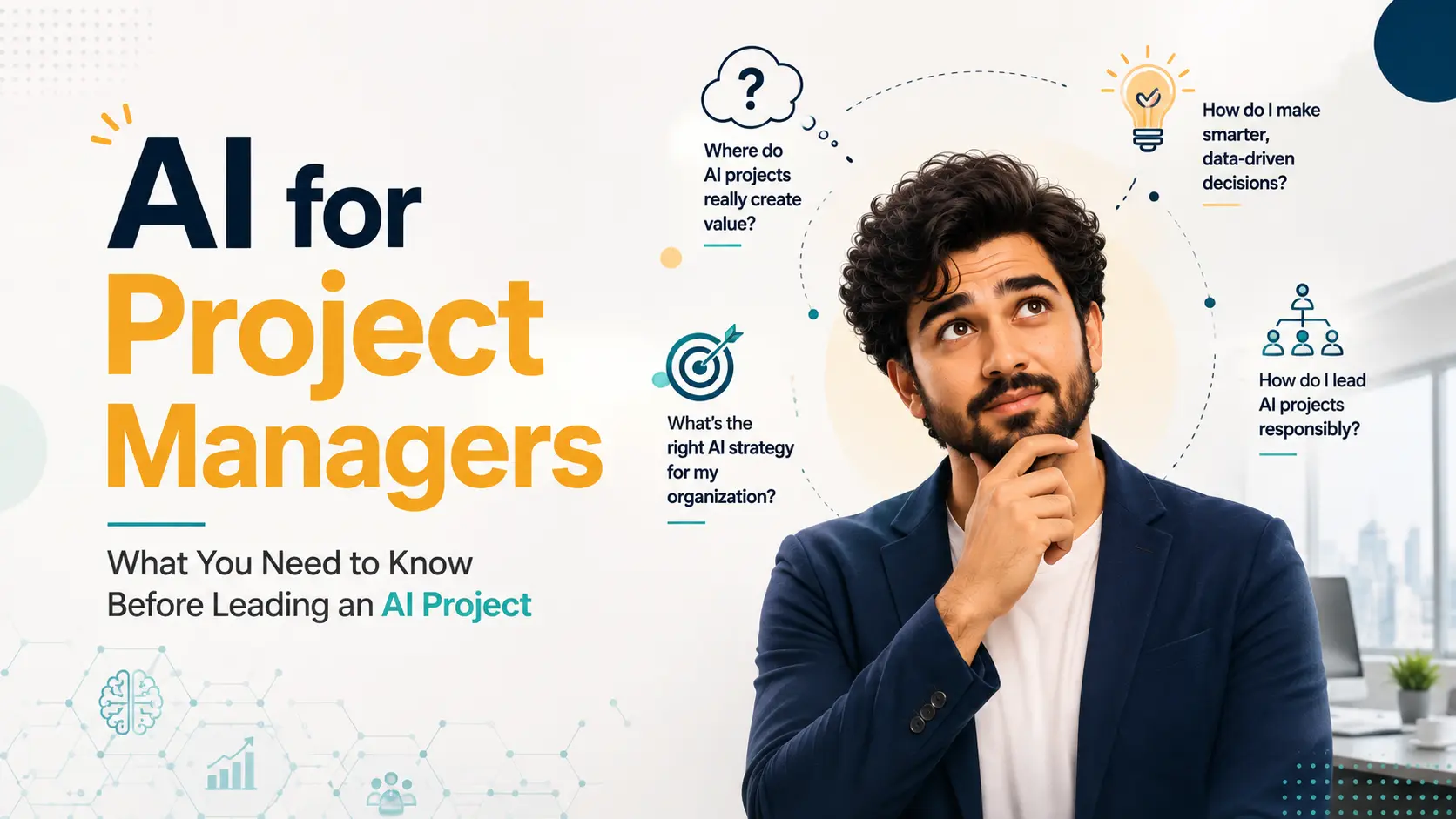
Every second AI conversation seems to begin the same way:
“We should build a chatbot.”
Maybe you should.
But before the team starts comparing tools, models or vendors, someone needs to ask the questions that usually arrive a little later than they should:
- What problem are we actually trying to solve?
- Who is going to use this?
- What information will it rely on?
- How will we know it is helping?
- What happens when it gets something wrong?
- And who owns it after the pilot ends?
That “someone” is often the project manager.
Project managers do not need to become data scientists to lead AI initiatives well. You do not need to write code, build models or explain the mathematics behind machine learning.
But you do need enough AI project management knowledge to make better decisions, ask better questions and keep business, data, technology, risk and operations teams moving in the same direction.
For professionals moving into AI-enabled work, the real question is not, “Do I need to become technical?”
It is:
“What AI project-management skills do I need to help an AI initiative become useful in the real world?”
The short answer
A project manager working on AI should understand how to:
- Define a business problem before choosing an AI tool.
- Treat data readiness as a core project dependency.
- Plan for testing, learning and uncertainty.
- Measure value beyond a convincing demo.
- Bring responsible AI and AI governance into the work early.
- Plan for user adoption, monitoring and ownership after launch.
You do not need to do the work of a data scientist or AI engineer.
You do need to make sure the right people answer the right questions before the project becomes expensive, complex or difficult to change.
What project managers need to know—and what they do not
| Project managers should understand | Project managers do not need to master |
|---|---|
| How to identify a useful AI use case | Coding or building machine-learning models |
| Why data quality, access and privacy affect delivery | Advanced statistics or deep-learning mathematics |
| How AI solutions are evaluated in real business scenarios | Selecting algorithms or model architectures |
| How to manage AI risk, governance and accountability | Doing the work of an AI/ML engineer |
| What adoption, monitoring and ownership look like after launch | Becoming the technical owner of the platform |
The goal is not to turn every project manager into a data scientist.
It is to ensure that someone can keep the conversation grounded when a team gets excited about an AI idea.
1. Start with the business problem—not the AI tool
“Let’s build a chatbot” is not a project objective.
It is one possible solution.
A better starting point is something like:
“Customers are waiting too long for answers to common policy questions.”
Now the team has a real business problem to examine.
Maybe a chatbot is the right answer. Or perhaps the issue is outdated content, poor website search, a confusing process or information scattered across too many systems.
This is one of the most valuable contributions a project manager can make to an AI initiative: helping the team define the need before it commits to the solution.
Ask:
- What process, decision or customer experience needs to improve?
- Who is affected by the problem?
- What would a measurable improvement look like?
- What does the current problem cost in time, quality, money or risk?
- Is AI truly the best approach, or is there a simpler way to solve it?
- Who owns the business outcome?
A good AI project begins with a business need—not a tool demonstration.
2. Data readiness for AI projects is part of the plan
In many AI projects, the first real issue is not the model.
It is the data.
Teams may have a lot of information, but that does not mean the information is useful for the proposed AI use case. It may be incomplete, inconsistent, scattered across systems, out of date, sensitive or unavailable to the people building the solution.
That is why data readiness needs to be visible in the project plan from day one.
A project manager should know:
- What data the solution will require.
- Where the data comes from.
- Who owns it.
- Whether access has been approved.
- Whether it is accurate and current enough for the intended use.
- Whether privacy, security or compliance constraints apply.
- How the data will be maintained after the solution goes live.
A practical rule: if nobody can clearly explain the data source, do not treat the delivery date as a promise yet.
It may still be a good idea. But the project is in discovery—not implementation.
3. Plan for discovery, not false certainty
Most project managers are trained to create certainty: define scope, plan milestones, manage dependencies and keep people accountable.
Those habits still matter in AI project management.
But AI initiatives also require room for discovery.
The team may learn that available data cannot support the use case. The model may perform well in testing but struggle with real-world inputs. Users may not trust it. A solution that looks promising in a pilot may become too costly, risky or difficult to operate at scale.
That is not necessarily a failure. It is part of learning what is realistically possible.
A useful AI project plan includes decision points, not just delivery dates.
| Project stage | The question the team needs to answer |
|---|---|
| Business discovery | Is this a meaningful problem worth solving? |
| Feasibility | Is AI a realistic and useful approach? |
| Data readiness | Do we have appropriate, accessible data? |
| Experimentation | Can the approach perform well enough? |
| Validation | Does it work in realistic user situations? |
| Deployment | Can it fit safely into the workflow? |
| Operations | Who owns, monitors and improves it? |
A strong AI project manager does not pretend every unknown has an answer.
They make the unknowns visible, define what needs to be tested and help the team decide what to do next.
4. Do not confuse a good demo with a good outcome
AI demos can look impressive in meetings.
That does not mean the organization has a useful AI solution.
A demo proves that something is possible under selected conditions. A successful AI project proves that the solution can be used, trusted, supported and improved in everyday work.
| A good demo proves | A successful AI project proves |
|---|---|
| The idea is technically possible | The business problem is worth solving |
| The system can generate an output | Users can rely on the output appropriately |
| The prototype works in a controlled setting | The solution fits into real workflows |
| The presentation goes well | There is ownership after launch |
This is why model accuracy should not be the only measure of success.
Depending on the project, the team may need to look at adoption, process time, customer experience, error reduction, user confidence, cost, operational reliability or risk reduction.
The question is not only, “Does the model work?”
It is also, “Does it help people make better decisions or get better work done?”
5. Responsible AI and AI governance start early
Responsible AI is not a final review at the end of the project.
It is part of responsible delivery from the beginning.
If questions about privacy, security, bias, transparency, accountability or appropriate use appear just before launch, the team may discover that key assumptions need to change.
Project managers do not need to become legal, risk or cybersecurity specialists. But they should ensure that specialists are involved early enough to influence the work.
Useful questions include:
- What information will this AI system access, use or generate?
- Does it involve personal, confidential or sensitive data?
- What happens when the output is wrong?
- Who can challenge or override the output?
- How will users understand its limitations?
- Who is accountable for risk and decision-making?
- How will the organization monitor unexpected behavior over time?
The NIST AI Risk Management Framework organizes AI risk management around four connected functions: Govern, Map, Measure and Manage. The key idea is simple: trustworthy AI requires ongoing work, not a one-time approval.nvlpubs.nist+1
6. Deployment is not the finish line
For many AI initiatives, going live is where the real work begins.
Real users bring real questions, exceptions and workarounds. Real data changes. The model may need monitoring. The business may need to refine the workflow. Someone must answer questions when the output seems wrong.
Before a pilot starts, ask:
“If this works, who owns it on Monday morning after the project team moves on?”
A complete AI delivery plan should cover:
- User training and communication.
- Support for questions and exceptions.
- Monitoring for performance and unexpected behavior.
- Data updates and quality checks.
- Incident and escalation processes.
- Clear ownership of changes and improvements.
- Periodic review of business value.
- A fallback or retirement plan if the solution no longer works as intended.
A project is not finished simply because the model has been deployed.
7. The real role of the AI project manager
The project manager does not need to be the most technical person in the room.
Their value lies in helping the organization have the right conversations before decisions become difficult to reverse.
That often means connecting:
- Business leaders who own the outcome.
- Product teams who understand the user journey.
- Data, engineering and AI teams that build the solution.
- Security, privacy, legal and risk teams that protect the organization.
- Operations teams that will support the solution after launch.
- End users who decide whether the solution becomes valuable or ignored.
The real job is bigger than keeping a timeline updated.
It is helping the organization turn an AI idea into something that is useful, responsible and sustainable.
Where (PMI-CPMAI)™ Fits
For project managers who want formal, structured training in AI project management, the PMI Certified Professional in Managing AI (PMI-CPMAI)™ certification is a relevant next step.
PMI-CPMAI certification is not about turning project managers into AI developers. It focuses on managing AI initiatives across business needs, data readiness, model development and evaluation, responsible and trustworthy AI, and operationalization.
In practical terms, it helps professionals understand the full AI project lifecycle—from the first business discussion to deployment, adoption and ongoing management.
PMI’s current PMI-CPMAI examination content outline covers five domains:
| (PMI-CPMAI)™ domain | Exam weight |
|---|---|
| Supporting responsible and trustworthy AI initiatives | 15% |
| Identifying business needs and solutions | 26% |
| Identifying data needs | 26% |
| Managing AI model development and evaluation | 16% |
| Operationalizing the AI solution | 17% |
The certification can be relevant for project managers, program managers, product managers, business analysts, technology managers, solution architects and digital-transformation professionals involved in AI-enabled work.pmi
If you want a structured way to build AI project-management capability and prepare for the certification exam, explore Acepro’s PMI-CPMAI™ Exam Preparation Program.
AI project readiness checklist
Before starting an AI project, see whether your team can answer these questions:
- What business problem are we solving?
- Is AI actually the right approach?
- What data will the solution need, and is it available and usable?
- What does “good enough” look like technically and in the real workflow?
- What happens when the AI output is wrong?
- Who will use the solution, and how will it fit into their work?
- Who owns risk, monitoring and support after launch?
- How will we decide whether to scale, change or stop the solution?
If some answers are unclear, it does not mean the idea is bad.
It means the next step is discovery—not a confident launch date.
Final thought
Project managers do not need to become data scientists to lead AI work effectively.
But they do need to understand that the hard part is often not choosing the model.
It is choosing the right problem, working with the right data, involving the right people, managing real risk and ensuring that the solution keeps creating value after the excitement of the demo has faded.
That is what effective AI project management looks like.
