



Artificial intelligence is changing the way organizations work. Businesses are using AI for automation, forecasting, customer service, risk analysis, product development, and operational improvement.
As AI adoption grows, organizations need more than professionals who can build AI models. They also need people who can identify the right business problems, coordinate teams, manage risks, and guide AI initiatives from planning to implementation.
This is where the CPMAI certification can help.
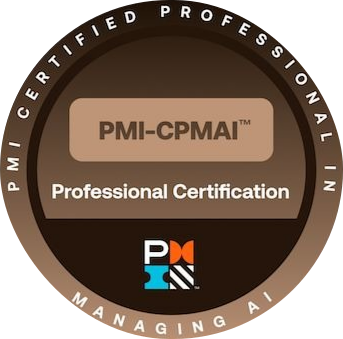
The (PMI-CPMAI)™, or PMI Certified Professional in Managing AI, is designed for professionals who want to manage and lead artificial intelligence initiatives. It focuses on applying a structured approach to AI projects rather than teaching advanced programming or model development.
But is PMI-CPMAI the right certification for you? Let us look at the eligibility criteria, suitable career profiles, and situations where another learning path may be more appropriate.
What Is PMI-CPMAI?
CPMAI is an AI project management certification from the Project Management Institute. It helps professionals understand how AI initiatives are planned, managed, evaluated, and delivered.
The certification focuses on connecting business goals with technical execution. This includes understanding the business problem, working with data and technology teams, managing stakeholders, identifying risks, supporting implementation, and promoting responsible AI practices.
You do not need to become a data scientist or machine learning engineer to pursue PMI-CPMAI. The certification is more suitable for professionals who want to lead AI projects, coordinate teams, and support organizations in adopting AI effectively.
PMI-CPMAI Eligibility Criteria
CPMAI does not require candidates to have an advanced technical degree or extensive programming experience. Professionals from project management, business analysis, product management, consulting, and technology backgrounds can consider this certification.
You may be a suitable candidate if you have:
- Basic exposure to project management, Agile, Scrum, or a similar approach.
- A general understanding of artificial intelligence and machine learning.
- Experience working with cross-functional teams.
- An interest in AI, automation, analytics, or digital transformation.
- The ability to understand business requirements.
- An interest in working with both technical and non-technical stakeholders.
You do not need coding experience to pursue PMI-CPMAI. However, a basic understanding of concepts such as data, machine learning models, automation, model evaluation, and responsible AI can make your CPMAI exam preparation easier.
In simple terms, if you understand how projects work and want to help organizations implement AI responsibly, you may be eligible for PMI-CPMAI certification.
Who Should Consider PMI-CPMAI?
PMI-CPMAI is particularly relevant for professionals who work between business and technology teams.
Project Managers
Project managers who want to move into AI and machine learning initiatives can benefit from CPMAI training. Their existing skills in planning, stakeholder management, risk management, and delivery coordination provide a strong foundation.
AI projects often involve uncertain requirements, data limitations, model evaluation, ethical concerns, and changing business expectations. CPMAI exam training can help project managers understand how AI initiatives differ from traditional projects.
Business Analysts
Business analysts working with data science, technology, or transformation teams can use PMI-CPMAI to improve their understanding of AI use cases and project requirements.
The certification can help them evaluate whether AI is appropriate for a business problem, identify expected outcomes, and communicate more effectively with technical teams.
Product Owners and Product Managers
Product professionals developing AI-enabled products or features must balance customer needs, business goals, data availability, technical feasibility, and responsible AI considerations.
PMI-CPMAI certification prep can help product leaders manage these factors more systematically and support better collaboration between product, engineering, data, and business teams.
Consultants and Technology Leads
Digital transformation consultants, automation specialists, technical leads, and technology managers may also benefit from CPMAI training.
These professionals often help organizations identify AI opportunities, plan implementation, coordinate teams, manage risks, and communicate progress to decision-makers.
PMI-CPMAI may be relevant across industries such as banking, healthcare, manufacturing, retail, telecommunications, consulting, and government.
Who May Not Benefit From CPMAI?
PMI-CPMAI is focused on managing AI initiatives. It is not a replacement for technical education in programming, statistics, or machine learning.
The certification may not be the best fit if:
- You want to become a data scientist or machine learning engineer.
- Your primary responsibility is building models or writing code.
- You are looking for an academic qualification in AI research.
- You want advanced training in mathematics, algorithms, or statistical modelling.
- You are interested only in learning specific AI tools.
- Your role involves very little project delivery or stakeholder interaction.
If your goal is to develop AI systems, you will need hands-on training in programming, data science, machine learning, databases, and software engineering.
PMI-CPMAI can complement technical knowledge, but it is not designed to replace it.
How CPMAI Exam Prep Can Help
A structured CPMAI exam prep plan can help you understand the AI project management methodology and apply it to real-world situations.
Effective CPMAI certification prep should help you learn how to:
- Identify and evaluate AI use cases.
- Understand the stages of an AI project lifecycle.
- Work with data-related requirements and risks.
- Evaluate AI solutions against business objectives.
- Manage stakeholders and cross-functional teams.
- Address responsible AI, privacy, fairness, and transparency.
- Respond to project scenarios involving scope, risk, data, and implementation.
The CPMAI exam is not only about memorizing definitions. It also requires you to understand how to make appropriate decisions during different stages of an AI initiative.
A suitable CPMAI exam training program can provide structured learning, practical examples, study guidance, and scenario-based practice to support your preparation.
Is PMI-CPMAI Right for You?
PMI-CPMAI may be a good fit if you want to:
- Manage or coordinate AI and machine learning projects.
- Move from traditional project management into AI project management.
- Lead collaboration between business and technical teams.
- Support AI adoption in your organization.
- Understand AI project risks and dependencies.
- Contribute to responsible and well-governed AI delivery.
- Connect AI investments with measurable business outcomes.
It may not be the right certification if your primary goal is to build AI models, conduct academic research, or learn programming from the beginning.
Final Perspective
(PMI-CPMAI)™ is designed for professionals who want to lead AI initiatives rather than develop the underlying models themselves.
It can help project managers, business analysts, product professionals, consultants, technical leads, and transformation specialists understand how AI projects are evaluated, planned, managed, and implemented.
Before beginning your CPMAI prep, consider your current experience and long-term career goals. If you want to connect business strategy with AI execution and help organizations adopt AI in a practical and responsible way, PMI-CPMAI may be a valuable next step.
To learn more about PMI-CPMAI certification, CPMAI exam preparation, and available CPMAI training options, visit our website or speak with our training team.